

If you’ve spent any time on parenting social media lately, you’ve probably heard the term “low-stim activities.” It seems like every other reel features a toddler quietly sorting pom-poms, playing with dried beans, or painting rocks while soothing music plays in the background.
But what exactly is a low-stim activity, and do kids really benefit from them?
The short answer: yes.
And before you panic, this is not a blog about throwing away every toy that lights up, sings, or requires batteries.
What Does “Low-Stim” Mean?
A low-stimulation (or low-stim) activity is exactly what it sounds like—an activity that doesn’t overwhelm a child’s senses with constant sounds, flashing lights, rapid rewards, or endless entertainment.

Think:
- Coloring
- Reading books
- Building with blocks
- Playing with Play-Doh
- Puzzles
- Nature walks
- Drawing
- Pretend play
- Water painting
- Gardening
- Sorting objects by color or size
Compare that to activities that provide constant stimulation, such as fast-paced videos, many mobile games, or toys that do most of the entertaining for the child.
The goal is not to eliminate stimulating activities. The goal is balance.
Why Are Parents Talking About It?
Many parents have noticed that after highly stimulating activities, some children seem more irritable, restless, or unable to settle into independent play.
Researchers have spent years studying how children learn, play, and regulate their emotions. While “low-stim parenting” itself is a trendy phrase, the science behind it is not new.
Studies consistently show that children benefit from opportunities for free play, independent play, creativity, and periods without constant entertainment.
In other words, children need some space to think.
The Secret Benefit: Boredom
Let’s talk about a word that strikes fear into the hearts of parents everywhere:
Bored.
As in: “Mom, I’m boooooored.”
Many of us immediately jump into action. We suggest activities. We provide entertainment. We become cruise directors.
But research suggests that boredom isn’t always a problem.
In fact, boredom can be the starting point for creativity.
When children aren’t being constantly entertained, their brains begin searching for something to do. That’s often when they build a fort, create a game, invent a story, or decide the family dog needs a very important tea party.
Children learn how to create fun instead of waiting for fun to be provided.
That’s a skill worth developing.
Low-Stim Activities Help Build Real-Life Skills
Low-stim activities may help children practice:
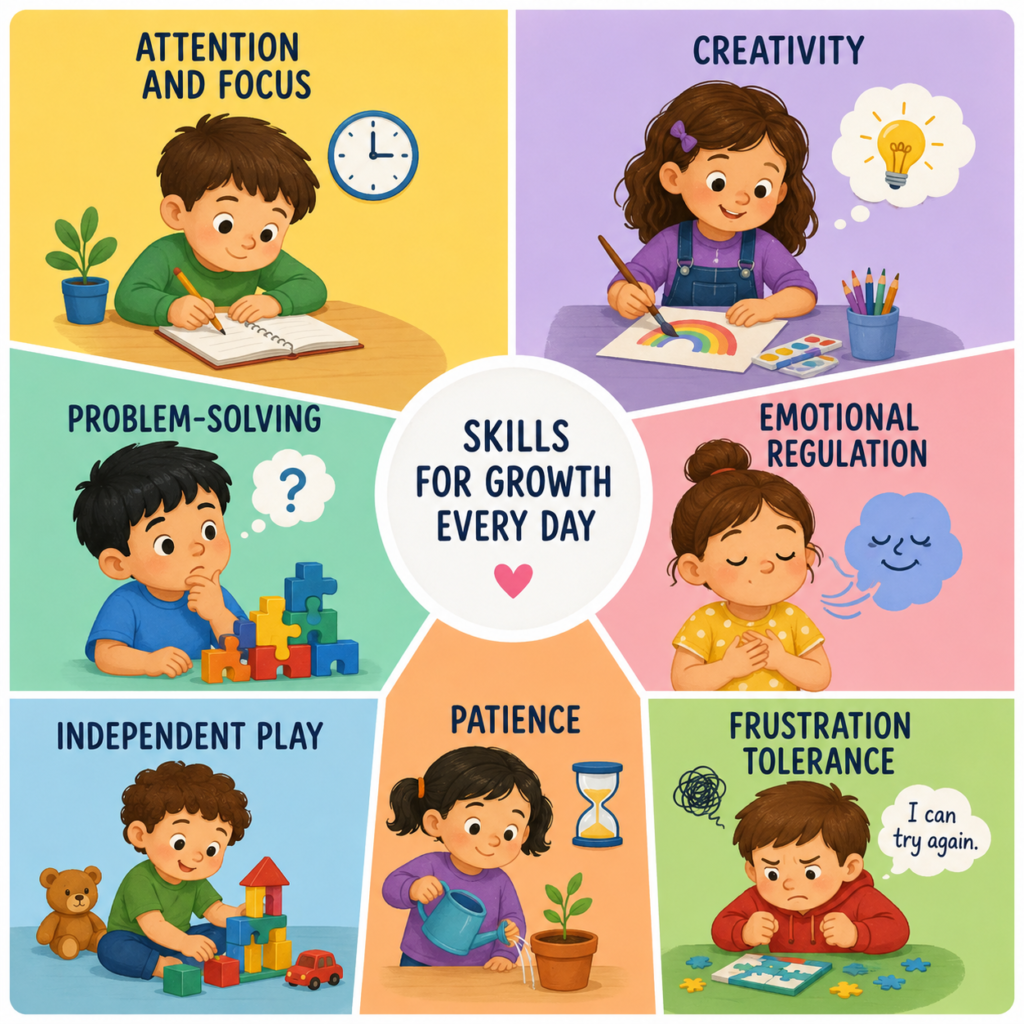
- Attention and focus
- Creativity
- Problem-solving
- Emotional regulation
- Independent play
- Patience
- Frustration tolerance
These are the skills that help children succeed in school, friendships, sports, and eventually adulthood.
The activity itself is often less important than what the child is doing mentally during the activity.
What About Screens?
This is not an anti-screen blog.
Screens are part of modern life, and most families use them.
However, the American Academy of Pediatrics encourages families to make sure screens do not replace important activities like sleep, reading, physical activity, family interaction, and free play.
The key is making sure children have opportunities to experience both stimulation and downtime.
Think of it as a balanced diet for the brain.
Nobody wants to live on broccoli alone.
Nobody should live on cupcakes alone, either.
Easy Low-Stim Ideas for Different Ages
Babies
- Looking at board books
- Tummy time
- Exploring safe household objects
- Listening to music
Toddlers
- Play-Doh
- Water play
- Sticker books
- Blocks
- Sensory bins
Preschoolers
- Coloring
- Pretend play
- Puzzles
- Nature scavenger hunts
- Building forts
School-Age Kids
- Reading
- Crafts
- Journaling
- LEGO creations
- Card games
- Gardening
The Bottom Line
The goal of low-stim activities isn’t to create perfectly calm children who sit quietly all day.
The goal is to give children opportunities to use their imagination, solve problems, tolerate a little boredom, and learn how to entertain themselves.
So the next time your child announces they are bored, try not to panic.
You do not have to become the entertainment committee.
Sometimes the best thing you can give a child is a little space, a little downtime, and the chance to discover that their imagination is actually pretty amazing.
And if they build a blanket fort that takes over your entire living room?
Well, that’s probably research in action.