

You know that feeling when your child wakes up with a fever the day before a beach trip, family reunion, birthday party, or long-awaited vacation?
Of course you do.
Because viruses apparently have access to everyone’s family calendar.
One of the most common culprits is Hand, Foot, and Mouth Disease (HFMD)—a childhood illness with a name that sounds like it was created by a committee that simply ran out of ideas.
“Where does the rash show up?”
“The hands, feet, and mouth.”
“Perfect. Let’s call it that and go to lunch.”
The good news? Despite its alarming name and dramatic appearance, Hand, Foot, and Mouth Disease is usually a mild illness that gets better on its own.
The surprising news? The version we’re seeing today isn’t always the same Hand, Foot, and Mouth Disease many parents remember from years ago.
Let’s talk about why.
What Exactly Is Hand, Foot, and Mouth Disease?
Hand, Foot, and Mouth Disease is a common viral illness caused by a group of viruses called enteroviruses. Historically, the most common culprit was Coxsackievirus A16.
According to the Centers for Disease Control and Prevention (CDC), Hand, Foot, and Mouth Disease most commonly affects children younger than five years old, although older children and adults can get it too.
The virus spreads through:
- Saliva
- Nasal secretions
- Respiratory droplets
- Contact with stool during diaper changes
- Shared toys and contaminated surfaces
Translation?
If one child in daycare gets it, the virus often treats the classroom like an all-you-can-eat buffet.
Why Does It Feel Like We’re Seeing More of It?
If you’re thinking, “I don’t remember Hand, Foot, and Mouth Disease being this bad when my older kids were little,” you’re not imagining things.
Over the past decade, a newer strain called Coxsackievirus A6 (CV-A6) has emerged as a more common cause of Hand, Foot, and Mouth Disease around the world.
According to the CDC and multiple published studies, CV-A6 often causes more severe and widespread symptoms than the classic strains.
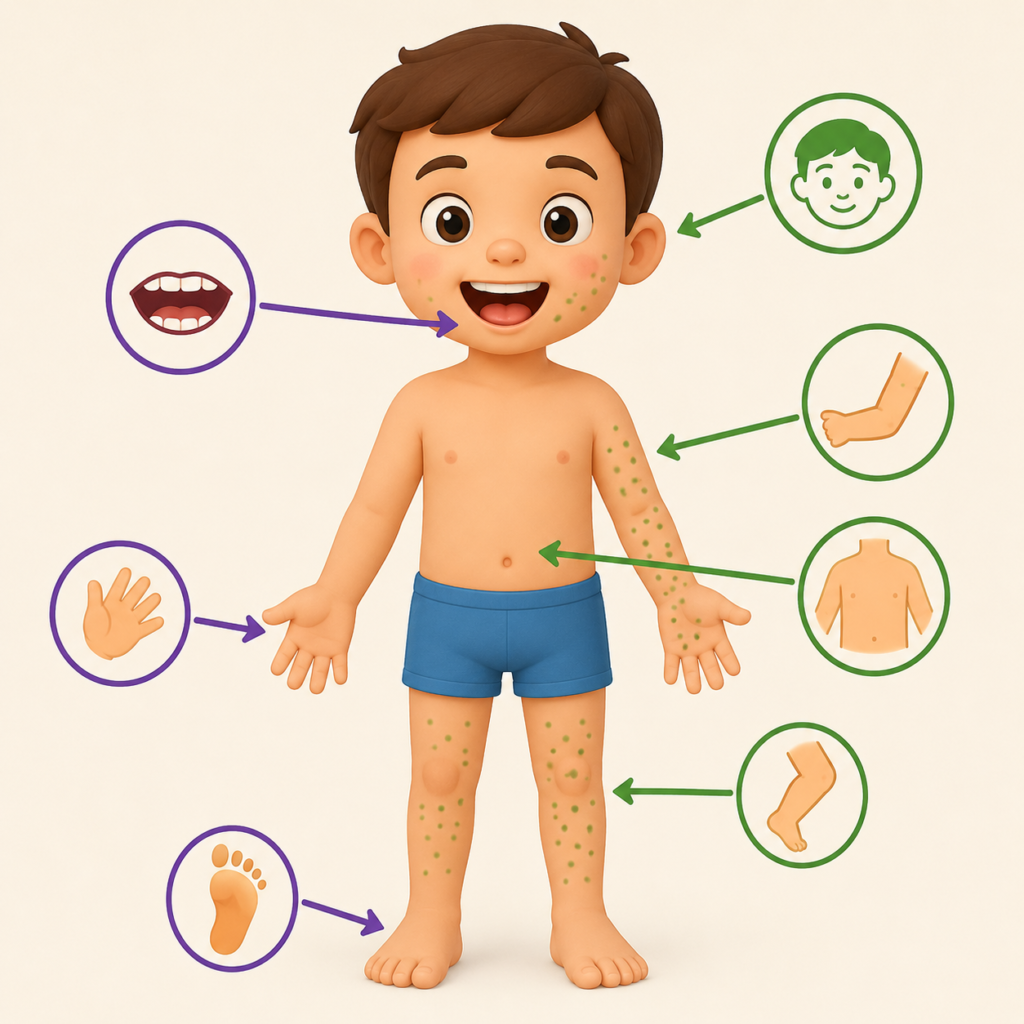
Back in the day, Hand, Foot, and Mouth Disease mostly stayed where its name suggested.
The newer strains apparently decided that was merely a recommendation.
Unlike traditional HFMD, Coxsackievirus A6 may cause:
- More extensive rashes
- Blisters on the arms and legs
- Rash around the mouth and face
- Rash on the trunk
- Illness in older children and adults
- More skin peeling during recovery
- Temporary fingernail or toenail shedding weeks later
So if your child’s rash is showing up in places that aren’t hands, feet, or mouth, that doesn’t automatically mean it isn’t Hand, Foot, and Mouth Disease.
The virus simply isn’t following the rules anymore.
What Are the Symptoms?
Symptoms usually develop three to six days after exposure.
Most children start with:
- Fever
- Fatigue
- Decreased appetite
- Sore throat
- General irritability
(Also known as “being three.”)
A day or two later, the classic symptoms begin.
Mouth Sores
Painful sores may develop on the tongue, gums, cheeks, roof of the mouth, or throat.
These sores are often the reason children suddenly refuse food, drinks, popsicles, snacks, favorite snacks, backup favorite snacks, and occasionally all forms of human interaction.
Rash and Blisters
The rash often begins as small red spots that can develop into blisters.
Common locations include:
- Palms
- Fingers
- Soles of the feet
- Toes
However, especially with the newer CV-A6 strain, we may also see rash on:
- Arms
- Legs
- Knees
- Elbows
- Buttocks
- Around the mouth
- Trunk
This is one reason many parents are surprised when we diagnose Hand, Foot, and Mouth Disease despite the rash showing up well beyond the areas listed in the name.
Is It Dangerous?
Thankfully, most cases are mild.
According to the American Academy of Family Physicians, most children recover completely within 7–10 days with supportive care alone.
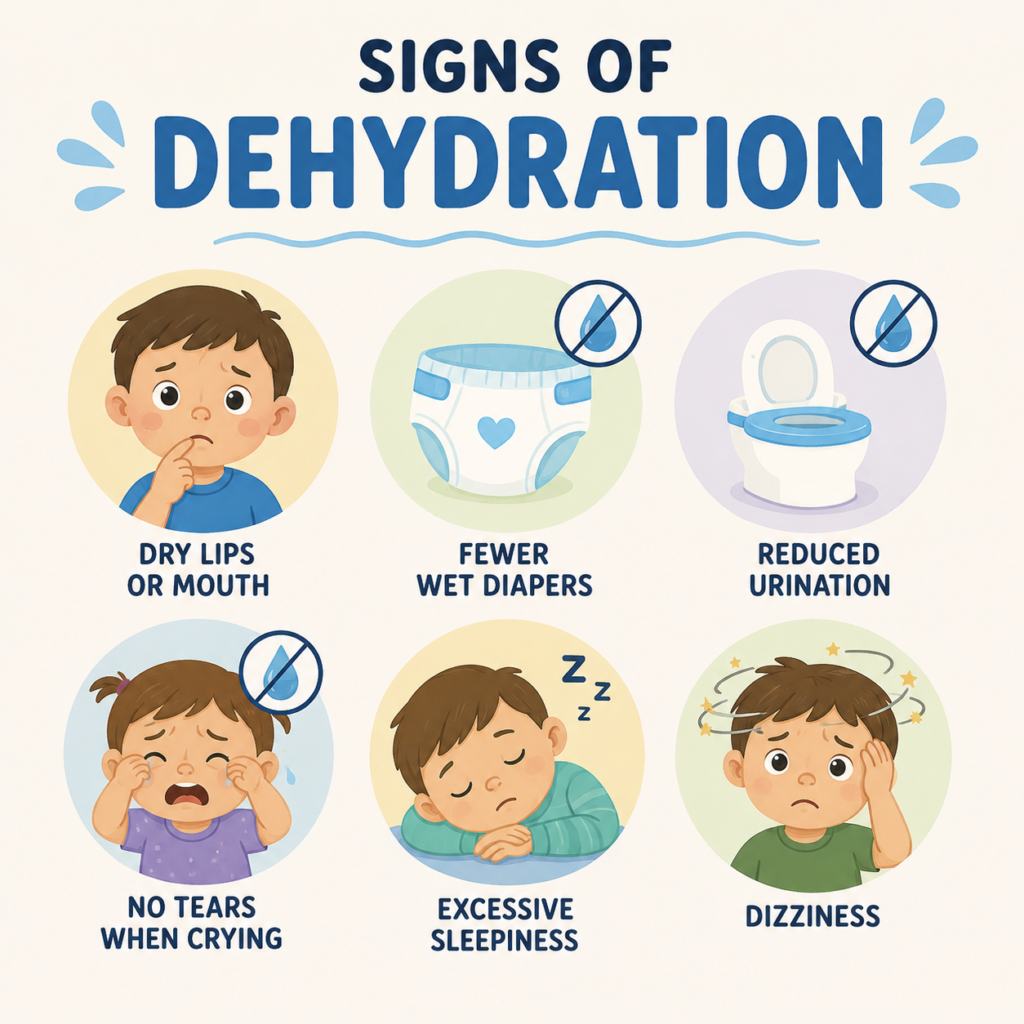
The biggest concern isn’t the rash.
It’s dehydration.
Because mouth sores can be painful, some children stop drinking enough fluids.
Watch for:
- Dry lips or mouth
- Fewer wet diapers
- Reduced urination
- No tears when crying
- Excessive sleepiness
- Dizziness
If your child is struggling to stay hydrated, it’s time to give us a call.
Wait…Why Are Their Fingernails Falling Off?
This is one of the strangest and most alarming parts of Hand, Foot, and Mouth Disease.
Several weeks after recovery, some children develop temporary nail shedding, a condition called onychomadesis.
Parents understandably panic.
The good news is that the nails almost always grow back normally.
Researchers have found that this is particularly associated with some of the newer strains, including Coxsackievirus A6.
It’s unusual.
It’s dramatic.
And fortunately, it’s usually harmless.
Can My Child Go Back to School, Camp, or Daycare?
This question frustrates parents because the answer isn’t perfectly straightforward.
According to the CDC, children are often most contagious during the first week of illness. However, the virus can continue to be present in stool for several weeks after symptoms disappear.
If we waited until the virus was completely gone, nobody would ever return to daycare.
Most children can return when:
- Fever has been gone for at least 24 hours
- They feel well enough to participate
- They can maintain hydration
- Their school or daycare policy allows return
Always check with your specific daycare or school for their requirements.
How Do We Treat It?
Unfortunately, there is no medication that cures Hand, Foot, and Mouth Disease.
Treatment focuses on keeping children comfortable while the virus runs its course.

Helpful options include:
- Plenty of fluids
- Popsicles
- Smoothies
- Cold drinks
- Acetaminophen or ibuprofen when appropriate
- Extra rest
Avoid acidic foods and beverages like orange juice if mouth sores are painful.
This may be one of the few illnesses where pediatric medicine officially endorses popsicles as part of the treatment plan.
When Should You Call KidMed?
Give us a call if your child:
- Isn’t drinking well
- Shows signs of dehydration
- Has persistent high fevers
- Seems unusually lethargic
- Has severe pain
- Has symptoms that don’t fit the typical pattern
And remember—not every rash is Hand, Foot, and Mouth Disease.
Google Images has convinced countless parents that their child either has a rare tropical disease or a medical condition that hasn’t been seen since the 1800s.
Fortunately, you don’t have to figure it out alone.
The Bottom Line
Hand, Foot, and Mouth Disease remains one of the most common childhood viral illnesses we see.
While newer strains like Coxsackievirus A6 have made the illness look a little different than it did years ago, the vast majority of children recover completely with rest, hydration, and a little extra TLC.
It’s uncomfortable.
It’s inconvenient.
It’s remarkably talented at appearing right before important events.
But most of all, it’s temporary.
And if you’re ever wondering whether that mysterious rash is Hand, Foot, and Mouth Disease—or something else entirely—the KidMed team is here to help.
Because while viruses don’t follow the rules, you can count on us to know the playbook.