
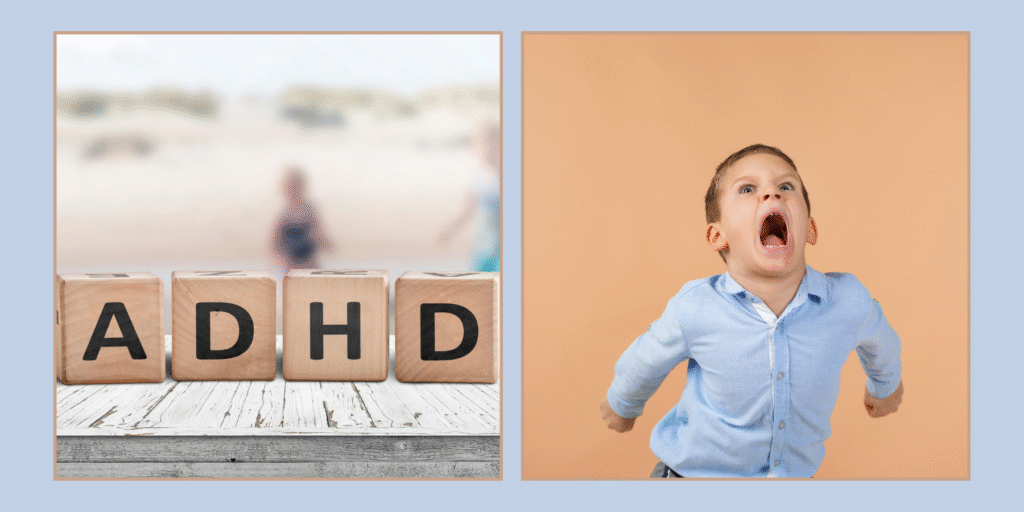
If you have ever looked at your child and thought, “Is this a neurological condition… or are you just being a tiny menace?” — congratulations, you are a normal parent.
One minute your kid is sweet, thoughtful, and capable of deep focus. The next minute they are bouncing off the walls, ignoring you like you are background noise, and arguing like they have a law degree.
So what is it? ADHD? Bad behavior? A phase? A lack of sleep? A full moon?
Let’s talk about it.
First, let’s clear something up: ADHD is not “kids behaving badly”
Attention-Deficit/Hyperactivity Disorder (ADHD) is a neurodevelopmental condition, not a discipline problem and not a parenting failure.
The American Academy of Pediatrics states ADHD affects how the brain manages attention, impulse control, and activity level. Kids with ADHD are not choosing to be disruptive any more than a child with nearsightedness is choosing not to see the board.
Important distinction:
- Bad behavior = can control it, chooses not to
- ADHD symptoms = difficulty controlling it, even when they want to
That difference matters.
What ADHD actually looks like (and it’s not just “hyper”)
Thanks to cartoons and stereotypes, many people think ADHD = nonstop energy and chaos. In reality, ADHD can show up in a few different ways.
According to the Centers for Disease Control and Prevention (CDC), common ADHD symptoms include:
- Difficulty sustaining attention (especially on boring tasks)
- Forgetfulness (homework, shoes, backpacks, all of it)
- Impulsivity (acting before thinking, blurting things out)
- Trouble with organization and time management
- Emotional intensity (big reactions to small things)
And here is a big one parents miss:
Kids with ADHD can hyperfocus on things they love (video games, art, Legos, dinosaurs), which makes it extra confusing when they cannot focus on homework for five minutes.
So… what is “just bad behavior”?

Bad behavior is usually:
- Situational
- Inconsistent
- Responsive to consequences
Examples:
- Your child listens perfectly at school but refuses to listen at home
- Behavior improves immediately when privileges are removed
- The behavior happens mostly when the child is tired, hungry, bored, or testing limits
According to Child Mind Institute, behavior issues tend to improve when expectations, structure, and consequences are clear and consistent.
In other words: if the behavior disappears when there is motivation or accountability, it is probably not ADHD.
The consistency test (this one matters)
One of the biggest clues is where and how often the behavior happens.
According to the DSM-5 (the diagnostic manual used by clinicians), ADHD symptoms:
- Are present in more than one setting (home, school, activities)
- Have been present for at least six months
- Interfere with daily functioning
So if a teacher, coach, babysitter, and grandma are all saying, “Something is going on here,” that is different from, “They are wild when they do not get their way.”
Age matters (a LOT)
All kids:
- Have big emotions
- Have poor impulse control
- Forget things
- Test boundaries
That is called normal brain development.
Harvard’s Center on the Developing Child notes that the parts of the brain responsible for impulse control and planning are still developing well into the mid-20s. Toddlers and preschoolers are especially impulsive by design.
Which means:
- A 3-year-old melting down is not ADHD
- A 6-year-old struggling to sit still all day might need a closer look
- A teen who suddenly cannot focus after years of doing fine may need screening for stress, anxiety, depression, or sleep deprivation
What ADHD is not
Let’s bust a few myths while we are here:
- ADHD is not caused by sugar
- ADHD is not caused by screens (though screens can make symptoms worse)
- ADHD is not a result of “lazy parenting”
- ADHD is not something kids grow out of because you yelled louder
According to the National Institute of Mental Health, ADHD is strongly linked to genetics and brain development, not parenting style.
When should parents actually be concerned?
You may want to talk to us if:
- Teachers are consistently raising concerns
- Homework is a daily emotional battle
- Your child is trying but still struggling
- The behavior is affecting friendships or self-esteem
- You find yourself thinking, “This feels bigger than typical kid stuff”
Trust that instinct. Parents are usually right when something feels off.
What a real ADHD evaluation looks like
A proper evaluation is not a five-minute conversation.
The American Academy of Pediatrics notes that an ADHD diagnosis should include:
- Parent input
- Teacher feedback
- Behavior rating scales
- Review of academic and social functioning
- Screening for anxiety, learning differences, sleep issues, and mood concerns
Because sometimes it is ADHD.
Sometimes it is anxiety.
Sometimes it is trauma, lack of sleep, or a learning difference.
And sometimes… it really is just a kid pushing boundaries.
If you suspect your child has ADHD, come and see us and we can refer you for proper, professional testing.
The bottom line
If your child is struggling, they are not doing it to you — they are doing it because something is hard.
ADHD is not an excuse for bad behavior.
But it is an explanation for certain challenges — and explanations help us support kids better.
And if it turns out your child does not have ADHD?
Great. You still learned more about how their brain works — and that is never a bad thing.