
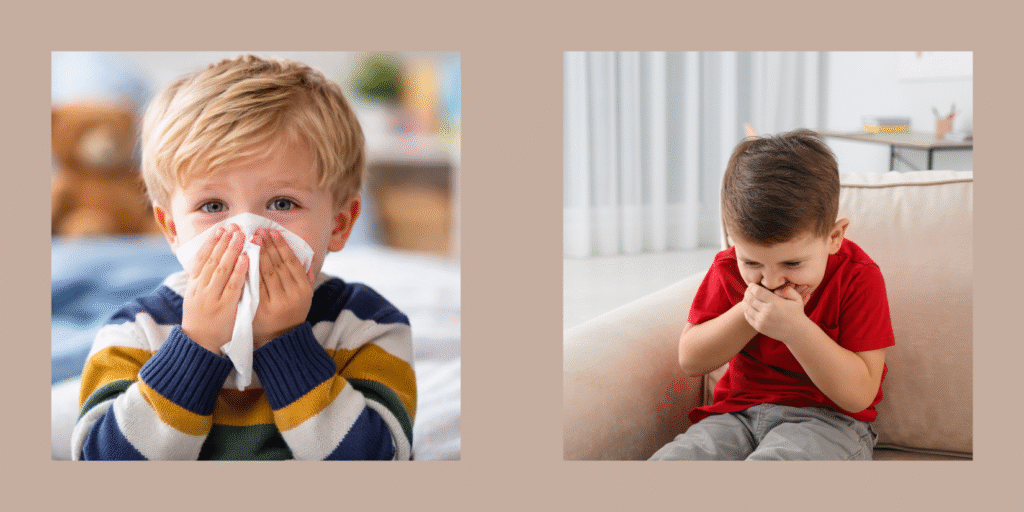
If it feels like your child has been sick every other week since October, you are not imagining things.
Parents say this to us all the time at KidMed.
“She just got over a cold… and now she has another one.”
“He had a stomach bug two weeks ago. How is he sick again?”
Take a deep breath. In most cases, the answer is actually pretty simple. Kids get sick a lot. And most of the time, it is completely normal.
Kids get far more colds than adults
Adults might catch two or three colds a year and feel like the world is ending.
Kids? Very different story.
According to the American Academy of Pediatrics, young children typically have about six to eight colds each year. The number can be even higher for children who attend daycare or preschool, where viruses circulate easily. Boston Children’s Hospital reports similar numbers, noting that many children experience six to ten colds annually, especially during the early years of childcare or school.
When parents hear those numbers, they often say something like, “Oh good… so it’s not just my house.”
Nope. It is pretty much every house with young kids.
Their immune systems are still learning
Babies are not born with fully trained immune systems.

Think of the immune system like a brand-new employee on the first day of work. It has to learn how to recognize germs and figure out how to respond.
Research discussed through the National Institutes of Health explains that early infections help train the immune system. Each time a child encounters a virus, the immune system builds memory and learns how to fight it more effectively the next time.
That training works. Boston Children’s Hospital notes that infection rates usually decrease after about age five or six, once children have built immunity to many common viruses.
So while the parade of runny noses and coughs can be exhausting, those early illnesses are actually helping build the immune system your child will rely on for the rest of their life.
There are a lot of cold viruses
Another reason kids seem sick all the time is that there are many different viruses that cause colds.
Researchers have identified more than 100 viruses that can lead to common cold symptoms. Because there are so many of them circulating, children can catch one virus after another before their bodies have built immunity.
Adults have already encountered many of these viruses over the years, which is one reason we tend to get sick less often. Kids, however, are basically meeting these germs for the first time.
Daycare and school spread germs very efficiently
We love daycare and preschool. Kids learn social skills, independence, and how to interact with others.
Unfortunately, they also learn how to share germs.
Studies examining respiratory infections in childcare settings show that children in group environments experience significantly more illnesses, particularly during their first year attending. Young children are very effective virus distributors. They touch everything. They forget to cover coughs. They share toys. They wipe their noses with their sleeves. And occasionally, they lick things that absolutely should not be licked.
In other words, daycare is wonderful for development… and fantastic for viruses.

Sometimes it is one virus after another
Cold symptoms can last about 10 to 14 days.
If a child catches another virus right after recovering from the first one, it can feel like one long illness that never ends. Parents often tell us, “He has been sick for two months,” but what actually happened was three separate colds back to back.
What about stomach bugs?
Parents ask this question a lot too.
“My child just had a stomach bug last month. How does he already have another one?”

It turns out stomach bugs behave in a similar way to colds.
First, the term “stomach bug” does not refer to a single virus. Several viruses cause viral gastroenteritis, including norovirus, rotavirus, adenovirus, astrovirus, and sapovirus. According to the Centers for Disease Control and Prevention, norovirus alone causes tens of millions of cases of gastroenteritis in the United States every year. That means a child who had a stomach virus recently may simply catch a different one a few weeks later.
Another challenge is that immunity to some stomach viruses does not last very long. The CDC notes that immunity to norovirus is temporary and incomplete, which means people can become infected multiple times in their lives.
And stomach viruses spread incredibly easily. The CDC reports that fewer than 20 viral particles can be enough to cause infection.
In households with young children, stomach bugs can sometimes turn into a family relay race. One child gets sick, then a parent, then a sibling, and suddenly it feels like the household has been dealing with the same virus for weeks.
When should parents worry?
Frequent illness is usually normal, but there are some situations where doctors look more closely. You should check in with us if your child has repeated pneumonia, unusually severe infections, infections requiring frequent hospitalization, poor growth or weight gain, or an unusually high number of ear infections.
These situations are uncommon, but they can signal rare immune problems. Most of the time, however, frequent childhood illness simply reflects a busy immune system doing its job.
The takeaway
If your child seems like they are sick all the time, it does not necessarily mean something is wrong.
In fact, it often means the opposite.
Those runny noses, coughs, and occasional stomach bugs are part of how a child’s immune system learns, grows, and builds protection for the future.
We know it is exhausting for parents. Nobody enjoys the parade of tissues, thermometers, and midnight fevers. But in most cases, those illnesses are simply the immune system saying:
“Thanks for the practice. I will be stronger next time.”
And eventually, it will be.

If you ever feel unsure about your child’s symptoms, we are always happy to help. At KidMed, we believe parents should feel heard, reassured, and supported—even during cold and stomach bug season. Sometimes the most helpful thing a pediatric office can say is simply:
Yes. This is normal. ❤️