
One minute your child is building sandcastles, chasing fireflies, or searching for the world’s tiniest crab. The next minute they’re sprinting toward you yelling, “A BUG BIT ME!”
Cue the dramatic inspection.
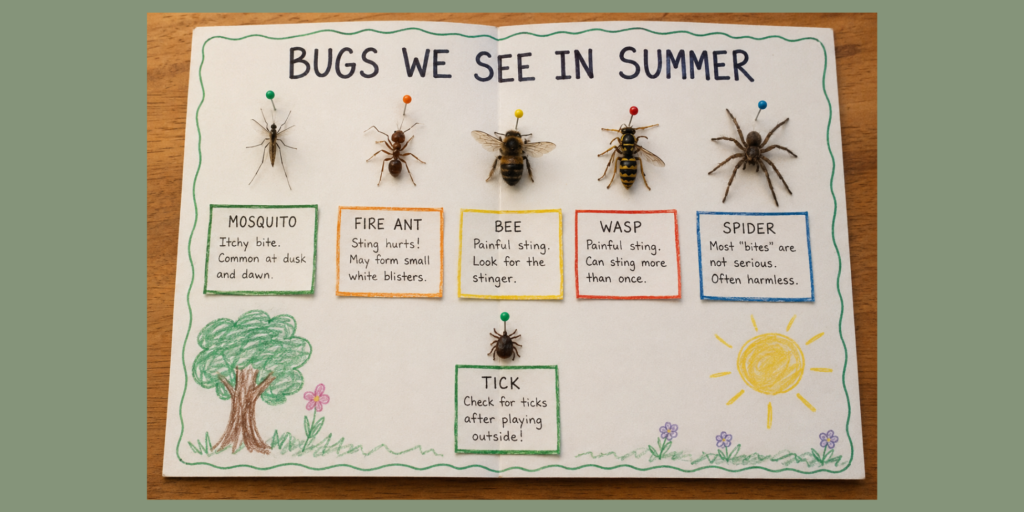
Is it a mosquito? A spider? A fire ant? Is it infected? Should we be worried?
Take a deep breath.
The good news is that most bug bites are more annoying than dangerous. At KidMed, we see plenty of itchy bites every summer, and most of them can be managed with a little patience, a little itch relief, and a whole lot of not scratching.
The trick is knowing what’s normal—and when it’s time to let us take a look.
Meet the Usual Suspects
🦟 Mosquitoes
Mosquitoes win the award for “Most Likely to Ruin a Backyard Barbecue.”
Most bites cause a small, itchy, red bump that improves over a few days.
Some children, though, have much bigger reactions. An arm or leg may swell dramatically after what looks like one tiny bite. It can be alarming, but it’s often something called Skeeter syndrome—an allergic reaction to mosquito saliva, not an infection.
🐜 Fire Ants
If you live along the Crystal Coast, you’ve probably met these little troublemakers.
Unlike mosquito bites, fire ant stings often form small white blisters within about 24 hours. They may look infected, but they’re actually a normal reaction.
As tempting as it is…don’t pop them.
🐝 Bees and Wasps
Bee and wasp stings usually hurt much more than they itch.
If you can see a bee stinger, gently scrape it away with a fingernail or the edge of a credit card. Ice packs and a little time usually help the discomfort fade.
🕷️ Spiders
Here’s a fun fact that surprises many parents:
Most “spider bites” aren’t actually spider bites.
Many mysterious red bumps blamed on spiders turn out to be mosquito bites, irritated hair follicles, or small skin infections. Unless someone actually saw the spider, it’s often impossible to know exactly what caused the bite—and that’s okay. We treat what we see, not just what we suspect.
✔️ Ticks
Ticks deserve a little more respect because they can carry illnesses like Lyme disease and Rocky Mountain spotted fever.
If you find one, remove it with fine-tipped tweezers by grasping it close to the skin and pulling straight upward. Skip the petroleum jelly, nail polish, matches, and internet folklore. Those methods don’t help and may actually make things worse.
Then simply wash the area with soap and water and keep an eye on your child over the next few weeks.
What’s Normal?
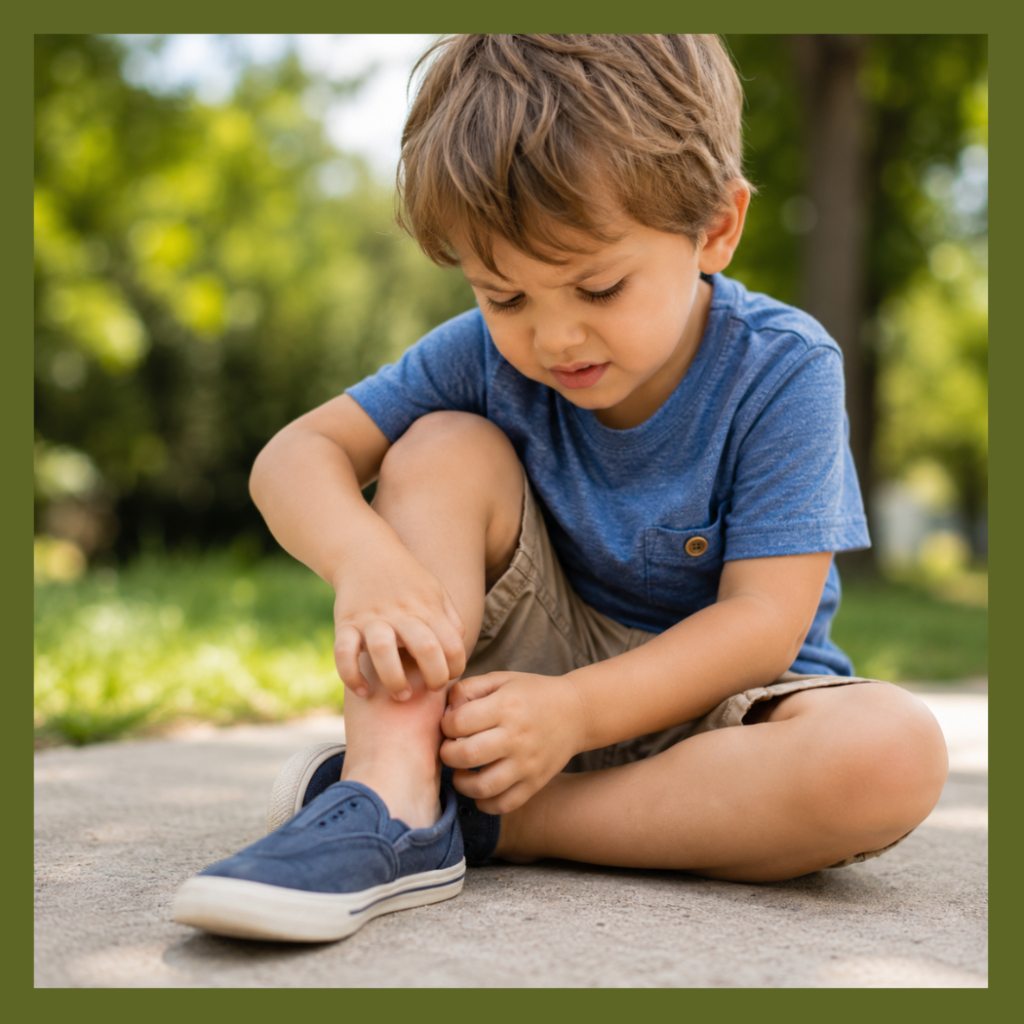
Most bug bites cause:
- Mild redness
- Itching
- A little swelling
- Tenderness for a day or two
Believe it or not, scratching usually causes more trouble than the bug bite itself. Broken skin makes it easier for bacteria to get in, turning an itchy bite into a true skin infection.
What Can I Do at Home?
For most bug bites, simple treatments work beautifully.
- Wash the area with soap and water.
- Apply a cool compress for 10–15 minutes.
- Keep little fingernails trimmed.
- Distract younger children (sometimes that’s the best medicine!).
- If your child is old enough, an over-the-counter 1% hydrocortisone cream may help with itching. Be sure to read the age recommendations and directions on any medication you choose, and if you’re unsure, give us a call.
Keeping the Bugs Away
The best bug bite is the one that never happens.
Our favorite prevention? Lightweight long sleeves and pants whenever they’re practical. They’re simple, effective, don’t wear off, and help protect against both mosquitoes and ticks.
Of course, we know it’s hard to convince a child wearing a swimsuit to put on long sleeves in the middle of July.
That’s where insect repellents come in.
According to the American Academy of Pediatrics, EPA-registered insect repellents—including products containing DEET or picaridin—are safe and effective when used according to the directions on the label.
If your family prefers a more natural option, oil of lemon eucalyptus also has good evidence supporting its effectiveness for children 3 years and older.
For babies younger than 2 months, skip insect repellents altogether. Instead, use mosquito netting over strollers or carriers, lightweight clothing, and avoid mosquito-heavy areas whenever possible.
Whatever product you choose, be sure to read the label for age recommendations and directions before using it.

A few KidMed tips:
- Spray repellent into your hands first, then apply it to your child’s face. Never spray directly into the face.
- Avoid your child’s hands since little hands often end up in little mouths and rubbing little eyes.
- If you’d rather not spray directly on your child, it’s also okay to lightly spray repellent on clothing, following the product directions.
- Wash repellent off with soap and water once your child comes inside for the day.
- Skip combination sunscreen-and-bug-spray products. Sunscreen needs to be reapplied more often than insect repellent.
And what would we probably skip for our own families?
Mosquito-repellent bracelets, ultrasonic gadgets, vitamin B supplements, and other gimmicks that simply haven’t been shown to work consistently. We’d rather see your child protected by something that’s been proven to work than covered in itchy bites—or worse, dealing with a tick-borne illness.
When Should I Call KidMed?
Most bug bites are harmless, but we’d like to see your child if they have:
- Difficulty breathing or swelling of the lips, tongue, or throat (call 911 immediately)
- Hives spreading over much of the body
- Fever after a bug bite
- Rapidly increasing redness, warmth, pain, or drainage
- A tick bite followed by a rash or flu-like symptoms
- Swelling that continues to worsen instead of gradually improving
- Any bite that simply doesn’t look right to you
Kelly’s Take
“After more than 30 years in pediatrics, I’ve learned that most bug bites aren’t emergencies—but they sure can make kids miserable. If you’re ever looking at a bite and wondering, ‘Is this normal?’ we’d much rather answer your question than have you spend the evening worrying. That’s exactly why we’re here.”
The Bottom Line
Bug bites are part of summer. So are popsicles, sandy shoes, and kids who somehow find every ant hill in eastern North Carolina.
Most bug bites are nothing more than an itchy inconvenience. But if you’re not sure whether your child’s bite is normal, don’t spend the afternoon scrolling through internet photos that all somehow look worse than your child’s. Give us a call, stop by KidMed, and let us help you get back to the important business of making summer memories.